


Every year, millions of people fall victim to tax scams that cost them thousands of dollars and put their personal information at serious risk. Whether it’s a fake IRS call demanding immediate payment or a phishing email claiming you have an uncollected tax refund, tax fraud schemes have become increasingly sophisticated. Understanding how these scams work and knowing how to protect yourself is no longer optional — it’s essential.
This comprehensive guide is designed to help tax filers, investors, and everyday citizens stay informed, recognize warning signs, and take action when something feels wrong. Just as traders must learn to identify who is behind the forex trading scams targeting financial markets, taxpayers need to recognize the fraudsters who exploit tax season to steal money and personal data.
What Are Tax Scams?
Tax scams are fraudulent schemes designed to steal money, personal information, or both by impersonating tax authorities, creating fake tax-related communications, or manipulating victims into making payments they don’t owe. These scams can target individuals, small businesses, and even large corporations. They occur year-round, but increase significantly during tax season when filers are actively engaged with tax-related communications.
The types of scams vary widely. Some involve impersonating the IRS over the phone; others involve fake tax preparers, fraudulent tax filing, or emails designed to steal login credentials. Understanding what you’re up against is the first step toward protecting yourself.
Why Do Tax Scams Increase During Tax Season?
Tax season scams surge between January and April for a simple reason: people are expecting communications from the IRS and tax-related services. Scammers exploit this heightened awareness and urgency to slip deceptive messages past people who might otherwise be more cautious.
During tax season, people are more likely to open an email claiming to be from the IRS, answer a phone call from a number labeled “IRS,” or click on a link offering to check their refund status. Fraudsters know this and time their campaigns accordingly. This psychological exploitation is similar to how CFD scams target traders during high-volatility market periods, when urgency clouds judgment.
How Do Tax Scams Work?
Tax fraud schemes operate through a range of deceptive tactics. Here’s how the most common ones work:
IRS Impersonation Phone Calls
In fake IRS calls scams, fraudsters call victims claiming to be IRS agents. They may use aggressive language, threaten arrest, deportation, or license revocation if the victim doesn’t pay immediately. They typically demand payment via wire transfer, gift cards, or cryptocurrency — all methods that are difficult to trace or reverse.
Tax Phishing Emails
Tax phishing emails arrive in inboxes looking nearly identical to official IRS communications. They often contain links to fake government websites designed to harvest usernames, passwords, and Social Security numbers. This is a form of identity theft protection failure — your data ends up in criminal hands.
Tax Refund Scams and Refund Fraud
In a tax refund scam, criminals file a fraudulent tax return using your personal information before you do. They claim your refund and redirect it to their accounts. When you try to file, the IRS alerts you that a return has already been submitted — an experience known as tax refund identity theft.
Fake Tax Preparers
Not all tax preparers are legitimate. Some set up temporary offices during tax season, charge high fees, inflate refunds, claim fabricated deductions, and then disappear. These tax filing scams leave victims responsible for IRS penalties and back taxes.
Social Security and Government Impersonation Scams
Government impersonation scams extend beyond the IRS. Scammers also pose as Social Security Administration agents, claiming your Social Security number has been suspended or linked to criminal activity. These social security scams often escalate into demands for personal information or money transfers.
If you have received a suspicious call, email, or letter claiming to be from the IRS or another government agency, consider documenting the details and reporting the incident. Early reporting can help prevent further losses — for you and for others who may be targeted next.
The Growing Threat of Tax Scams: What You Need to Know
According to the IRS, taxpayers lose hundreds of millions of dollars each year to income tax fraud and tax-related scams. The latest tax scams in 2026 have evolved to become more targeted and technically sophisticated. Cybercriminals are now using AI-generated voice messages, spoofed caller IDs, and professional-looking websites to deceive even tech-savvy users.
Much like cryptocurrency scams that use complex blockchain terminology to confuse investors, modern tax scammers layer technical jargon and official-looking documents to make their schemes appear credible. Financial fraud awareness is a critical defense in both scenarios.
The IRS releases an annual “Dirty Dozen” list of the most dangerous tax scams each year. This tax scam alert is a valuable resource for staying up to date on the latest fraud tactics — and should be reviewed by every taxpayer before and during filing season.
5 Red Flags That Indicate a Tax Scam
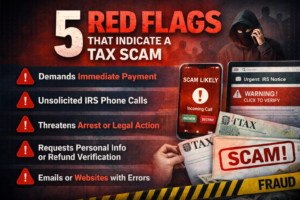
Knowing the common tax scam warning signs can help you avoid becoming a victim. Watch for these major red flags:
- Pressure and urgency. Legitimate IRS communications never demand immediate payment. If someone is pressuring you to pay within hours or face arrest, it’s a scam.
- Unusual payment methods. The IRS accepts payments through official channels. Requests for gift cards, wire transfers, or cryptocurrency are hallmarks of fraud.
- Threats and intimidation. IRS agents do not threaten taxpayers with arrest, deportation, or legal action over the phone without prior written notice.
- Unsolicited contact. If you receive an unexpected call, email, or text claiming to be from the IRS — especially if you weren’t expecting one — treat it with suspicion.
- Requests for personal information. Legitimate agencies never ask for your Social Security number, bank account details, or login credentials over the phone or via email.
How Tax Scams Target Vulnerable Populations?
While anyone can be targeted, certain groups are at higher risk. Elderly individuals are frequently targeted by tax scam phone calls because they may be less familiar with digital fraud tactics. Immigrants are targeted with threats about deportation linked to alleged tax debt. Small business owners face scams related to false tax credits, fake audits, and phantom employees.
New investors and those unfamiliar with financial systems are also prime targets. The same deceptive psychology found in investment scams — where fraudsters exploit financial inexperience — is applied by tax scammers to convince victims that their situation is urgent and that paying immediately is the only way out.
Understanding how these scams target specific groups is key to community-level awareness. Sharing information about scam tactics with elderly family members, recent immigrants, and new business owners can make a real difference.
7 Ways to Protect Yourself from Tax Scams
Online tax fraud prevention requires a combination of vigilance and practical steps.
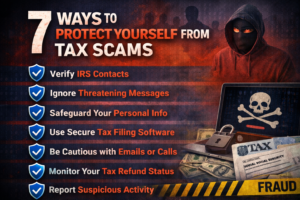
Here are seven evidence-based strategies for staying safe:
- File your taxes early. Filing before fraudsters can use your information reduces the risk of tax refund identity theft.
- Use a secure, reputable tax software or a verified tax preparer. Check credentials with the IRS’s online directory.
- Enable multi-factor authentication on your IRS online account and any tax-related services you use.
- Never click on links in unsolicited emails claiming to be from the IRS. Navigate directly to IRS.gov instead.
- Review your credit reports regularly. Identity theft can show up in unexpected places before you realize your information has been stolen.
- Use strong, unique passwords for all financial accounts and tax-related portals — a cornerstone of identity theft protection.
- Report suspicious activity promptly. The sooner a scam is reported, the better the chance of limiting damage.
The Impact of Tax Scams on Your Finances
The financial damage from tax fraud can be substantial and long-lasting. Victims of tax refund identity theft may wait months or even years for the IRS to process their legitimate return while the fraud is investigated. Victims of fake tax preparers may face penalties for false deductions they didn’t know were claimed in their name.
Beyond direct financial losses, victims often experience damaged credit, difficulty obtaining loans, and emotional stress that affects their daily lives. Online shoppers who unknowingly share financial data with online scam websites — a risk highlighted in guidance on how to shop safely online — may find their banking information connected to broader fraud networks.
Cybercrime alerts issued by the IRS and the Federal Trade Commission (FTC) highlight the scale of this problem. Staying informed about these alerts is an important part of financial fraud awareness.
If you are facing unexpected tax issues, unusual IRS correspondence, or believe your information may have been used without your knowledge, documenting and reporting the incident promptly is advisable. Users can securely report suspicious tax activity through established scam reporting agencies and platforms dedicated to fraud prevention.
Tax Scams: Myths and Facts You Should Know
Myth: “The IRS will call me if I owe money.”
Fact: The IRS contacts taxpayers primarily by mail. Phone calls may occur in certain cases, but only after multiple written notices have been sent. An unexpected IRS phone call demanding immediate payment is almost always a fake IRS calls scam.
Myth: “I’ll know a scam email when I see it.”
Fact: Modern tax phishing emails are sophisticated. They replicate IRS logos, formatting, and language with high accuracy. Many victims are experienced internet users who still get deceived.
Myth: “Only older people fall for these scams.”
Fact: All age groups are targeted. Young adults are frequently victims of tax refund scams and digital phishing because they file taxes online and interact heavily with digital communications. No demographic is immune to the various types of scams that exist in the tax fraud ecosystem.
How to Report a Tax Scam: A Complete Guide
Knowing how to report a tax fraud case is critical — both for protecting yourself and for helping law enforcement shut down criminal operations. Here is where to report tax scams based on the type of fraud:
IRS Phishing and Scam Emails
Forward suspicious emails claiming to be from the IRS to phishing@irs.gov. Do not click any links or open attachments before forwarding.
IRS Phone Scams
Report tax scam phone calls to the Treasury Inspector General for Tax Administration (TIGTA) at 1-800-366-4484 or online at tigta.gov. You can also report to the FTC at reportfraud.ftc.gov.
Tax Refund Identity Theft
If someone has filed a tax return using your Social Security number, complete IRS Form 14039 (Identity Theft Affidavit). File it with your return or send it separately to alert the IRS.
Fraudulent Tax Preparers
Report unscrupulous tax preparers to the IRS Return Preparer Program and your state’s tax authority. You can also contact the IRS Whistleblower Office if you have information about significant tax fraud.
When Should You Be Concerned About Tax Scams?
You should be concerned any time you receive an unsolicited contact claiming to be from a tax authority, especially if it involves urgency, threats, unusual payment requests, or requests for sensitive personal information. Trust your instincts — if something doesn’t feel right, verify independently before taking any action.
How to Protect Yourself from Tax Scams: A Step-by-Step Guide
Protecting yourself from IRS tax scam attempts requires both knowledge and action. Follow these steps at the start of every tax year:
- Step 1: Set up an IRS online account. This allows you to monitor your tax records, view any correspondence the IRS has sent, and verify payments.
- Step 2: Obtain an IRS Identity Protection PIN. This six-digit number prevents someone else from filing a tax return with your Social Security number.
- Step 3: Use reputable tax software. Choose established, well-reviewed software with secure encryption and two-factor authentication.
- Step 4: Verify any tax professional you hire. Use the IRS’s Preparer Tax Identification Number (PTIN) directory to confirm credentials.
- Step 5: Monitor your mailbox and email. Stay alert for unusual correspondence. If you receive a notice you didn’t expect, verify it directly on IRS.gov.
- Step 6: Educate yourself year-round. Tax scam alert notices and cybercrime alerts are published regularly by the IRS, FTC, and other agencies. Bookmark their sites and check in periodically.
Latest Tax Scams in 2026: New Tactics to Watch
The landscape of tax fraud is constantly evolving. In 2026, several new and intensified tactics have emerged that every taxpayer should be aware of:
AI-Powered Voice Cloning
Fraudsters are using AI tools to clone the voices of real IRS employees and create convincing audio messages. This makes tax scam phone calls harder to detect than ever before. If you receive a suspicious voicemail, do not call back the number provided — look up the official IRS contact number independently.
Fake Tax Relief Companies
Scammers are setting up fake tax relief services that promise to settle your tax debt for “pennies on the dollar.” They charge large upfront fees and then disappear or do nothing. This is a variation of the broader scam prevention tips topic that applies equally to investment fraud and financial fraud awareness.
Text Message Phishing (Smishing)
Smishing involves fraudulent text messages that appear to come from the IRS. These texts often link to fake refund claim pages that steal personal information. Remember: the IRS does not initiate contact via text message.
Tax Scam Victims Help: What to Do If You’ve Been Scammed
If you believe you’ve already fallen victim to a tax scam, don’t panic — but do act quickly. Time matters when it comes to limiting financial damage and protecting your identity.
- Contact your bank or financial institution immediately if you made a payment or shared financial information.
- Place a fraud alert or credit freeze with the major credit bureaus (Equifax, Experian, TransUnion).
- File an identity theft report with the FTC at IdentityTheft.gov.
- Report the scam to the IRS, TIGTA, and local law enforcement.
- Document everything — screenshots, recordings, emails, and transaction records.
- Consider seeking professional assistance from a licensed tax professional or attorney to address any fraudulent returns filed in your name.
You are not alone, and being scammed does not mean you were careless. These fraudsters are sophisticated criminals who deceive thousands of people each year. What matters now is taking the right steps to protect your future.
How to Avoid Tax Scams: Practical Scam Prevention Tips?
Preventing tax fraud starts with habits. These everyday scam prevention tips can significantly reduce your risk:
- Never share your Social Security number unless absolutely necessary and with verified entities only.
- Shred tax documents before discarding them — physical mail theft remains a common method of identity theft.
- Avoid using public Wi-Fi when accessing tax portals or submitting financial documents.
- Verify the URL before entering any credentials on a tax-related website — look for “https” and the correct domain.
- Be skeptical of unsolicited offers for tax credits, refunds, or relief programs — verify with the IRS directly.
- Keep your contact information updated with the IRS so you receive official correspondence promptly.
- Talk to family and friends about tax scam awareness — social sharing is one of the most effective forms of fraud prevention.
Take Action: Report Tax Scams and Protect Others
Tax scams thrive when victims stay silent. Every report matters — not just for the individual, but for the broader effort to hold fraudsters accountable and shut down harmful schemes before they claim more victims.
If you believe you have encountered a suspicious broker, a misleading tax scheme, a fake IRS representative, or a tax filing scam of any kind, consider reporting the incident in detail. Sharing your experience — even anonymously — may help protect others from the same fate and initiate appropriate review by the relevant authorities.
At ScamsReport.net, we are committed to helping victims of financial fraud find a path forward. Whether you are dealing with tax refund identity theft, a fraudulent withdrawal issue, or a suspicious broker, you can file a complaint and submit your evidence securely through our platform. Our team takes every submission seriously and works to connect victims with appropriate resources and guidance.
Free Consultation
Worried about the costs of seeking help? At Scams Report, we offer free consultation to assess your case and provide guidance on the best course of action. Our experts will listen to your story, evaluate your situation, and offer tailored advice to help you navigate the recovery process.
Contact Scams Report, and let us assist you in your journey towards recovery and justice. Your financial well-being is our priority, and we’re here to support you every step of the way.
Visit our LinkedIn Page