

Social Media Scams: The Ultimate Guide to Recognizing and Reporting Online Fraud

Social media has fundamentally changed how people connect, communicate, and share their lives. But alongside its many benefits, it has also created fertile ground for a growing and sophisticated world of social media fraud. From fake profiles designed to steal your identity to elaborate investment schemes promoted by fraudulent influencers, online social media scams now affect millions of people every year — across every platform, country, and demographic. This guide is designed to help you understand how these scams operate, what warning signs to look for, and what steps to take if you or someone you know has been targeted.
Inside the World of Social Media Scams: What You Need to Know
Social networking scams have evolved dramatically over the past decade. What once involved crude, easily spotted messages from unknown contacts has matured into highly coordinated operations that exploit real platform features, mimic trusted brands, and leverage behavioral data to target individuals with alarming precision. Understanding the landscape of these threats is the first step in building meaningful protection.
Social media platforms are uniquely vulnerable to exploitation because they are built on trust, community, and engagement. Scammers study these dynamics carefully and craft schemes that feel native to the environment — a giveaway that looks like a brand promotion, a direct message that reads like a friend’s voice, or an investment opportunity that appears to come from a credible financial figure. The question How Do Cryptocurrency Scams Work? is one many users have asked after falling victim to exactly this kind of engineered trust on platforms like Instagram and Telegram.
The scale of the problem is significant. Consumer fraud agencies in North America, Europe, and Australia consistently report that social media is now one of the top channels through which financial fraud is initiated. And the numbers continue to grow as platforms expand and users spend more time online.
What Are the Most Common Social Media Scams?
Before examining how to protect yourself, it is important to understand the types of scams you are most likely to encounter. Different platforms host different kinds of fraud, though many schemes cross platform boundaries with ease.
5 Types of Social Media Scams You Should Know About
1. Impersonation Scams
Fake social media accounts designed to impersonate real people — celebrities, business leaders, government officials, or even your own friends and family — are among the most common forms of social media fraud. These fake profiles are used to solicit money, extract personal information, or promote fraudulent schemes. Impersonation scams appear on every major platform, from Facebook scams involving cloned profiles to Twitter scams using handles that closely mimic verified accounts.
2. Social Media Giveaway Scams
Social media giveaway scams are structured to appear as legitimate brand promotions. Users are told they have been selected as winners and asked to click a link, pay a shipping fee, or provide personal details to claim their prize. These scams are particularly common on Instagram scams and Facebook scams, where they mimic the appearance of genuine promotional campaigns.
3. Romance Scams on Social Media
Romance scams on social media involve fraudsters building fake emotional relationships with victims over weeks or months before requesting money. The scammer typically presents as an attractive, successful individual — often claiming to be working overseas — and gradually earns the victim’s trust before introducing financial hardship that requires urgent assistance. These schemes can cause devastating emotional and financial harm.
4. Investment Scams on Social Media
Investment scams on social media have surged in recent years, particularly those involving crypto scams on social media. Fraudsters pose as successful investors or use fake influencer scams to promote investment platforms that guarantee extraordinary returns. Victims who deposit funds often find they cannot withdraw their money and have no recourse. This connects to a broader question many traders ask: Why Do CFD Scams Target Traders? The answer, in part, is the same — these schemes exploit financial ambition in environments where verification is difficult.
If you have encountered a suspicious investment opportunity on any social media platform, consider documenting your experience and reporting it. Early reporting can help prevent further losses for you and others.
5. Phishing Messages on Social Media
Social media phishing involves messages that appear to come from trusted contacts or official accounts, directing recipients to fake login pages or malicious links. Once a user enters their credentials, scammers gain access to their account — enabling social media account hacking, identity theft, and further fraud targeting their contacts. WhatsApp scams and Telegram scams frequently use this method, often claiming that the recipient’s account has been compromised and urging immediate action.
10 Warning Signs of Social Media Scams
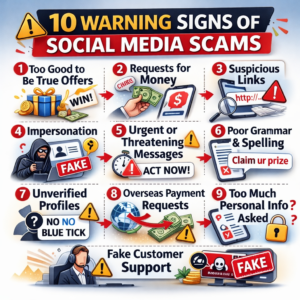
Recognizing warning signs of social media scams before engaging with a suspicious message or offer is your most effective line of defense. The following indicators appear consistently across different types of social media fraud.
- Unsolicited contact from strangers. Whether it is a friend request, a direct message, or a comment offering help, unexpected outreach from unknown accounts should always be treated with caution.
- Promises of guaranteed returns. Any investment opportunity — particularly those involving crypto scams on social media — that guarantees profit is almost always fraudulent. No legitimate investment carries zero risk.
- Requests for personal or financial information. Legitimate organizations never ask for passwords, bank account details, or identification documents through social media messages.
- Pressure to act quickly. Urgency is a manipulation tactic. Scammers create artificial deadlines to prevent victims from thinking clearly or seeking advice.
- Profiles with few followers, limited history, or inconsistencies. Fake social media accounts often have recently created profiles, stock photos as profile pictures, and minimal post history.
- Links to unfamiliar or misspelled websites. Social media phishing links often lead to websites that closely resemble legitimate platforms but have slightly altered domain names.
- Offers that seem too good to be true. Whether it is a social media giveaway scam or a fake influencer promotion, extraordinary offers without clear legitimacy are a reliable red flag.
- Requests for payment via unusual methods. Scammers commonly request payment through cryptocurrency, gift cards, or wire transfers — methods that are difficult or impossible to reverse.
- Messages with poor grammar or generic language. While sophisticated operations have improved their writing quality, many phishing messages on social media still contain notable errors or overly generic phrasing.
- Contact from someone impersonating a known brand or public figure. A social media scam alert should go off any time you receive communication from an account claiming to represent a major organization or celebrity without verification.
Why Do People Fall for Social Media Scams?
The Psychology Behind Social Media Scams
Understanding why intelligent, cautious people can fall victim to online social media scams requires a look at psychology. These schemes are not random — they are engineered to exploit specific cognitive tendencies and emotional states.
Social proof is one of the most powerful tools in a scammer’s arsenal. When a fraudulent investment post shows thousands of likes and positive comments — many of them from fake accounts — real users perceive popularity as credibility. This same principle explains what makes fake influencer scams so effective: when someone with a large following endorses a product or opportunity, followers are conditioned to trust that endorsement.
Emotional vulnerability is another key factor. Romance scams on social media succeed because they target the fundamental human desire for connection and love. Victims are not naive — they are human. Similarly, Who Is Most at Risk for Investment Scams? is a question whose answer often includes people experiencing financial stress, those new to investing, and individuals who have been isolated from traditional financial education. Scammers find these individuals on social platforms and offer them what feels like a solution.
Digital familiarity can also create a false sense of security. Users who have spent years on a platform become comfortable with its interface, which makes them more susceptible to phishing messages on social media that closely mimic that interface. Comfort breeds reduced vigilance.
Where Do Social Media Scams Typically Occur?
Top 10 Social Media Scams to Watch Out For by Platform
- Facebook scams range from marketplace fraud and fake charity appeals to cloned profile impersonation and fake lottery notifications. With billions of active users, Facebook remains one of the most targeted platforms globally.
- Instagram scams frequently involve fake influencer promotions, social media giveaway scams, and investment opportunities tied to crypto scams on social media. The platform’s visual nature makes it easy for fraudsters to create convincing personas with fabricated lifestyles.
- WhatsApp scams leverage the private, encrypted nature of the platform to conduct romance scams, phishing, and investment fraud. Victims receive messages that appear to come from trusted contacts whose accounts have been compromised.
- Telegram scams are particularly prevalent in the cryptocurrency space. Fraudulent investment groups and fake trading signal channels are widespread, often using social media account hacking to add victims’ contacts without consent.
- Twitter scams have historically centered on impersonation of high-profile figures and giveaway fraud, though the platform’s evolving moderation landscape has created new vulnerabilities for users.
- LinkedIn, though often perceived as more professional, is not immune. Social networking scams involving fake recruiters, investment opportunities, and online identity theft are increasingly common on the platform.
Users can securely report suspicious social media activity on any of these platforms to scamsreport.net, where complaints are reviewed and patterns are tracked to support broader fraud awareness efforts.
How to Identify and Avoid Social Media Scams?
Step-by-Step Guide to Protecting Yourself from Social Media Scams
Protecting yourself from social media fraud does not require technical expertise — it requires consistent habits and a clear understanding of how scammers operate. The following steps form a practical framework for staying safe.
7 Tips to Protect Yourself from Social Media Scams
- Verify before you trust. Before engaging with any unfamiliar account or offer, look for verified badges, cross-reference the account on official websites, and check for independent reviews.
- Enable two-factor authentication. Adding an extra layer of security to all your social media accounts significantly reduces the risk of social media account hacking.
- Be skeptical of direct messages involving money or investments. Whether it is a stranger offering financial advice or a ‘friend’ asking for urgent assistance, treat all such messages with caution until independently verified.
- Do not click links in unsolicited messages. Social media phishing links are among the most common entry points for online identity theft. Type website addresses directly into your browser instead.
- Review your privacy settings regularly. Limiting who can see your personal information reduces your visibility to scammers who use data harvesting for targeted fraud.
- Educate those around you. Digital fraud prevention is a community effort. Sharing scam awareness tips with family, friends, and colleagues — particularly those who may be less familiar with online threats — is one of the most effective protective measures available.
- Report suspicious accounts and messages. Reporting not only protects you but also helps platforms and investigators identify and remove fraudulent operations before they reach more victims.
When Should You Be Concerned About Social Media Scams?
You should be alert to social media fraud any time an interaction involves unexpected financial opportunity, an urgent request, or a sense that you are being asked to bypass your normal judgment. This includes when a new contact quickly turns the conversation toward money, when an offer arrives unsolicited and seems unusually generous, or when someone asks you to keep a financial transaction confidential.
A social media scam alert is also warranted any time you receive a message claiming your account has been compromised, requiring you to verify your details through an unfamiliar link. Legitimate platforms handle account security through official, in-app notifications — not through direct messages from other users or unofficial email addresses.
The intersection of social media and financial platforms has also created new opportunities for fraud. Traders who use social media to research markets or connect with investment communities should be particularly cautious. The question Where to Report Forex Trading Scams? is relevant here — many such scams are initially promoted through social media channels, and reporting them to appropriate platforms is an important step in disrupting their operations.
How to Report Social Media Scams Effectively?
Knowing how to report social media scams effectively is an important part of digital fraud prevention. Many victims hesitate to report because they feel embarrassed or believe their report will not make a difference. In reality, every report contributes to a larger body of evidence that investigators and platform safety teams rely on to identify and dismantle scam operations.
A Comprehensive Guide to Social Media Safety and Scam Prevention: Reporting Steps
Document the scam thoroughly. Before reporting, gather all available evidence — screenshots of messages, profile links, payment receipts, email addresses, and any other communications. This documentation is vital for any formal investigation.
Report directly on the platform. Every major social media platform has built-in reporting tools for fake accounts, phishing, and fraud. Use these tools to flag the offending account or content so the platform’s safety team can review it.
File a complaint with consumer protection authorities. Depending on your country, this may include your national consumer protection agency, the financial crimes unit of your local law enforcement, or a dedicated internet crime division.
Contact your bank if funds were transferred. If you have sent money or shared banking details as part of a social media fraud incident, notify your bank immediately. They may be able to block transactions, flag suspicious activity, or advise on further steps.
Submit a report to a trusted scam reporting platform. Platforms like Scamsreport.net allow victims to share the details of their experience in a secure environment. These reports help build a public record of fraudulent operations and provide expert guidance for what to do if scammed on social media.
If you are facing withdrawal issues from an investment platform you found through social media, documenting and reporting the incident creates an important record. Early action is always more effective than delayed reporting.
Take Action: Report a Social Media Scam Today
Social media scams thrive when victims stay silent. Every day that a fraudulent account remains active is another day it can target someone new. If you believe you have encountered a suspicious profile, a misleading investment offer, a fake giveaway, or any other form of social media fraud, your experience is valuable — and sharing it could protect someone else.
At Scamsreport.net, you can file a complaint, submit evidence, and seek expert guidance in a safe and confidential environment. Whether you are a victim of romance scams on social media, crypto scams on social media, or an impersonation scheme, the process of reporting is straightforward and does not require you to have all the answers.
You do not need to feel certain that what happened to you was a scam to make a report. Submitting your experience — even a suspicious interaction that did not result in financial loss — contributes to a growing body of evidence that helps researchers, investigators, and platform safety teams identify patterns and act.
Seeking Help After a Scam? Recover and Prevent with Scams Report
If you’ve fallen victim to social media scams, don’t face it alone. Reach out to Scams Report for assistance. We offer a free consultation to guide you through the recovery process and help prevent future scams. Your security is our priority.
Visit our LinkedIn Page